For many, summertime means camping, gardening, and fun days at the pool.
Unfortunately, this time of year can also bring insufferable heat that forces us to crank up the air conditioner and stay indoors.
While being inside is not exactly ideal, learning more about the differences between air conditioning and a whole house fan with air ventilation can allow you to create the cleanest and most comfortable living space for you and your loved ones during muggy days.
In this article we will go beyond the simple facts that air conditioners spit out cool air and ventilation systems pull fresh air into a home. We’ll address questions like: what exactly are the differences between ventilation and ac systems? Are our air conditioners making us sick? Can an air conditioning system provide clean air? And can a ventilation system be used to cool the air?
What is air conditioning?
When we think about ‘air conditioning’ we usually think about systems that remove heat to cool the ambient air. We often have air conditioners in our homes, public buildings, and cars not only to make a space more comfortable, but safer from the dangerous heat.
It’s probably not surprising that an AC unit is one of the best ways to cool off and prevent heat-related illness.
But in reality air conditioning systems provide a living space with a lot more than just a comfortable temperature. Air conditioners work much like refrigeration systems, by not only cooling a space, but simultaneously improving its humidity level and air quality.
How does an air conditioner work?
Air conditioning systems have two main parts: a condensing unit and an evaporator.
The condensing unit is usually located outside the building and contains fans, condensing coils, a compressor, and refrigerant.
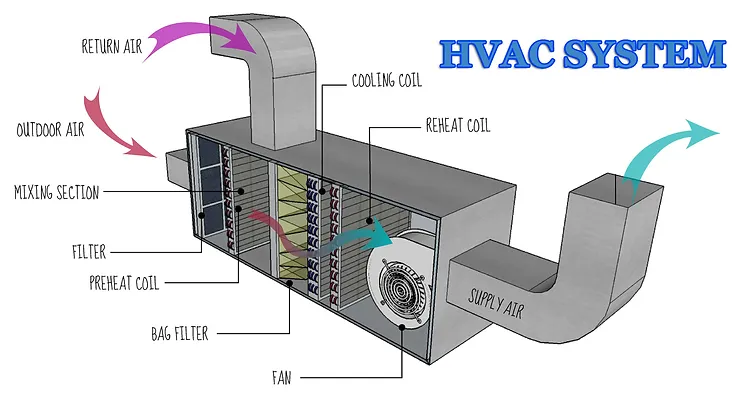
The evaporator is often located inside a home. This unit contains evaporator coils, a circuit board, filters, and fans to draw in warm air and disperse cool air throughout a space.
The process starts when the temperature in a room rises above a certain point. The circuit board is triggered and activates fans inside and outside the house. Warm, humid air is taken in by the condensing unit. The compressor sends refrigerant between the condensing coils (outside the house) to the evaporator coils (inside the house).
While this is happening the warm air inside the house is taken in by the evaporator and blown across the evaporator coils that contains refrigerant. Heat and moisture are removed during this process and cold air is returned to the living space. This process continues until the thermostat finds that the room is at a desirable temperature.
What is the cost of air conditioning?
Costs of installing and operating central air conditioning can vary significantly depending on the size of the home and the difficulty of installing additional components such as ductwork.
The typical range of central air installation is usually between $3,700 and $7,250 according to homeadvisor.com.
What are the benefits of air conditioning?
An efficient air conditioning system will function by cooling homes and removing moisture regardless of the outside temperature. This is especially important in extremely hot and humid areas where indoor air conditioning is the only solution to escaping these outside conditions.
Humidity control is another benefit that air conditioning systems have on the overall air quality in a building. Harmful microbes like mold do not handle the cooler and drier environments that humans thrive in.
What are the downsides of air conditioning?
The price of installing, maintaining, and operating central air conditioning systems can be quite costly compared to, say, natural ventilation.
Another potential downside of air conditioning is the associated health concern. Many people believe that breathing in contaminants from their air conditioning systems could make them sick.
While it is possible that your air conditioner may make you sick, it’s unlikely.
In fact AC systems are beneficial and sometimes even vital to our health. Apart from the heat protection that air conditioners provide, healthy indoor air quality and clean air is an obvious benefit. If maintained and cleaned regularly, air conditioning systems will help filter out pollen, mold, and pollution from your living environment.
In a few rare cases the water in air conditioning units have become infected with a bacterium called Legionella which causes Legionnaires’ disease in humans. While the disease could be quite dangerous, outbreaks seldom occur and the disease is usually treatable.
What is air ventilation?
Ventilation provides a building with fresh air by pulling clean outdoor air into a building. It can also remove dirty or stale indoor air from a space by pushing it outdoors.
While air conditioning systems perform the same process of air circulation (and are thus a type of ventilation system), there are several types of ventilation that we don’t generally associate with air conditioning systems.
Natural ventilation is the most simple type of ventilation. Opening windows to allow air flow may be all that’s necessary in mild climates to provide a home with fresh air. If the weather outside is suitable, natural ventilation could also cool down a home (meaning no need for an air conditioner that contains refrigerants).
Mechanical ventilation systems are a little more complex than just letting air flow in and out through a building’s openings. These systems often use fans and vents to pull air into and push air out of a home.
Central air conditioning and heating systems are both modes of mechanical ventilation. As we’ve said above, air conditioners remove a volume of warm, moist air from a space and replace it with cool, clean air.
How does an air ventilation system work?
Natural ventilation relies on the stack effect. Air always moves from areas of high pressure to low pressure areas, meaning that until equilibrium is met there will be air flow and circulation in and out of a building.
Balanced mechanical ventilation systems such as central air conditioning, once activated, use fans to move air in and out of the home at an equal volume.
What is the cost of air ventilation systems?
Natural air ventilation systems can be fairly cheap to install and essentially free to run because of its energy efficiency. While costs are, of course, dependent on a number of factors windows are often just a few hundred dollars to install.
Mechanical ventilation systems can range in price from essentially free for simple bathroom exhaust fans to thousands of dollars for a complicated HVAC system.
What are the benefits of air ventilation systems?
All ventilation systems improve air quality by providing and circulating fresh air throughout a home.
Some modes of ventilation, especially ‘natural ventilation’ systems are extremely energy efficient and cheap to install, run, and maintain.
If outdoor conditions are right, natural ventilation could even cool a home down.
What are the downsides of air ventilation systems?
The major downside to natural ventilation is that outdoor conditions need to be desirable to be effective. Natural ventilation is just not ideal in extremely hot, humid, or frigid climates.
So, is there a difference between air conditioning and air ventilation?
Simply, air conditioning systems cool a home down and ventilation systems provide a space with fresh air from the outdoors.
However, both systems provide more than solely what their name may implies.
Air conditioning systems are a type of ventilation (specifically mechanical ventilation) because they provide a space with cool, fresh air. Some air conditioning systems qualify as ‘balanced ventilation’ because they also remove stale and polluted air from a building.
So, obviously some types of ventilation provide cooler air, but it is not true that all ventilation systems can cool down a building.
If the outdoor conditions are right, natural ventilation can provide an extremely cheap alternative to complicated air conditioning systems.
Ideally a home takes advantage of both cooling and moisture-removing aspects of air conditioning as well as the fresh air and energy efficiency provided by ventilation.